Fri. September 4, 6pm
Al Hinkle, childhood friend of Neal Cassady, stalwart friend and confidant to Jack Kerouac, Allen Ginsberg, and the Cassady family, and key member of the Beat Generation circle was born September 4, 1926. Join us for an evening of stories, memories, and tributes with Al’s daughter, Dawn, and son, Mark, in celebration of his 100th birthday.
This is a free event.
Al Hinkle
Sept. 4, 1926 – Dec. 26, 2018
Albert C. Hinkle was born in Miami on Sept. 4th, 1926. That same year, following a devastating hurricane, the Hinkle family left Florida bound for Salt Lake City. When they ran out of money they settled in Denver, sleeping in abandoned cabins until Al’s father found work as a policeman.
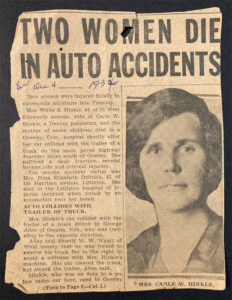 “Two Women Die in Auto Accidents,” newspaper clipping, 1934
At age 8, tragedy struck when Al’s mother was killed in an auto accident. His father remarried, and Al did his best to keep himself busy and out of the house, delivering newspapers, magazines, handbills, and mowing lawns. At age 12, he first met Neal Cassady. The two became fast friends and spent time training in acrobatics at the local YMCA, particularly the trapeze. Al—already six feet tall at twelve—was catcher and Neal was flyer. Years later, Al joked that he was still trying to keep Neal from falling. But sooner or later life got in the way, and they didn’t see each other again until age 19.
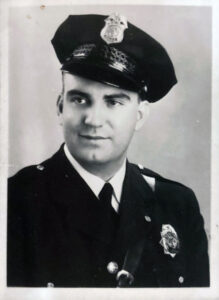 Al Hinkle’s father, Carle W. Hinkle, in police uniform
At age 15 he set off on his first road trip, and after leaving home at age 16, Al worked a number of jobs from construction to fry cook, as an airplane mechanic for the Army Air Corps, and at a Lockheed plant assembling airplane parts, which brought him to southern California. When he learned the Merchant Marines would take 16-year-olds, he joined up, and after six weeks of military-style basic training, shipped off aboard the passenger liner SS Monterey. During the journey from San Francisco to New Orleans via Hawaii, he served as ship’s librarian, attended union meetings, and wielded a mop when some 290 WAVES (Women Accepted for Volunteer Emergency Service) spent the voyage quite seasick.
Hinkle’s second voyage was on a Victory freighter, working as a pantryman in the crew’s mess. While unloading cargo by lighter (barge) while in port, the ship was hit by a Japanese bomb. Thankfully, there were no casualties, and Hinkle and the rest of the crew eventually returned to the US.
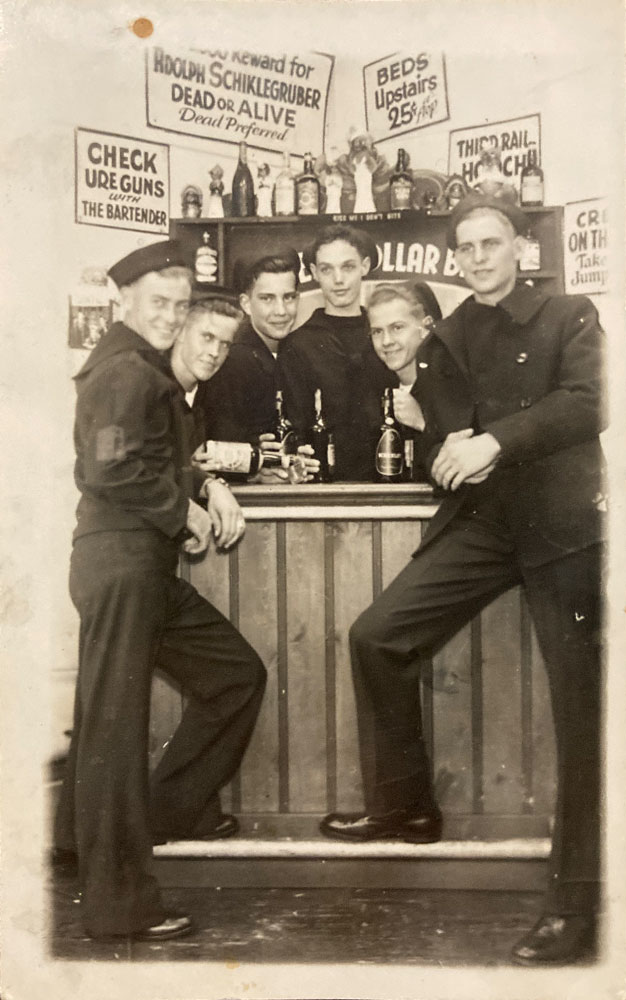 Al Hinkle (far right) with fellow Merchant Marines
His third voyage with the Merchant Marines took him from Long Beach to San Fernando in the Philippines. Fighting had moved on at that point, and only a few straggling Japanese soldiers remained, yet he witnessed two, likely starving, get shot trying to steal food. It was the closest Hinkle came to seeing combat in WWII.
After his return to Long Beach, he received word that his grandfather was remarrying, so he quickly caught a Greyhound back to Denver, making it just in time for the wedding. Once in Denver he stayed in cheap hotels and crashed on friends’ couches. He became reacquainted with an old friend, Jane, who begged him to take her to California with him when he returned to duty with the Merchant Marines. He bought a cheap 1928 Chevy sedan to get there, and had to ask his younger brother, Melvin, to teach him to drive. After collecting enough ration stamps (it was still wartime) for gasoline, he and Jane were on their way. When they reached the San Fernando Valley (the California one this time), Jane and her mother reunited, Al spent a few days helping them build a house, then continued on, leaving the car with Jane.
Returning to the Merchant Marines, his next journey was through the Panama Canal to New York. From there the cargo was cattle, bulls bound for Antofagasta in northern Chile. A strange city, with Chilean cavalry patrolling the streets on horseback carrying sabres, not a single automobile in sight, and a picture of Hitler in every shop window on the main street. There one of Al’s crew, a Polish citizen, got into some trouble in the red light district. He claimed a pimp had stolen his watch, and a fight broke out when he attempted to retrieve it. Amidst the fracas he was arrested for injuring a cavalryman, and though the whole crew chipped in for his legal defense, even the American Embassy couldn’t help him, and they never knew what became of their shipmate.
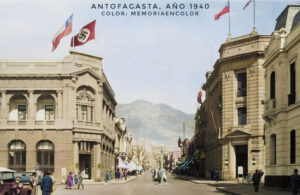 Postcard from Antofagasta, Chile, 1940
Upon returning to New York, their ship was sold to a South American company, and everyone was out of work again. Al was out of money, but made a deal with the union to travel to Europe to picket the Dutch government (over what grievance it isn’t clear), after which they’d provide him a little money to get home. He smuggled aboard some pints of whiskey, which he sold to troops that boarded at Le Havre, and made enough money to return to Denver. WWII ended in December 1945, and so did Al’s career in the Merchant Marines.
Back in Denver, Al worked a job in shipping while reconnecting with family. With his union experience, he organized his previously non-union shop, and with one short strike got a pay raise to one dollar and 9.5 cents an hour. He went out and bought a Buick straight-8 LaSalle convertible for $75.
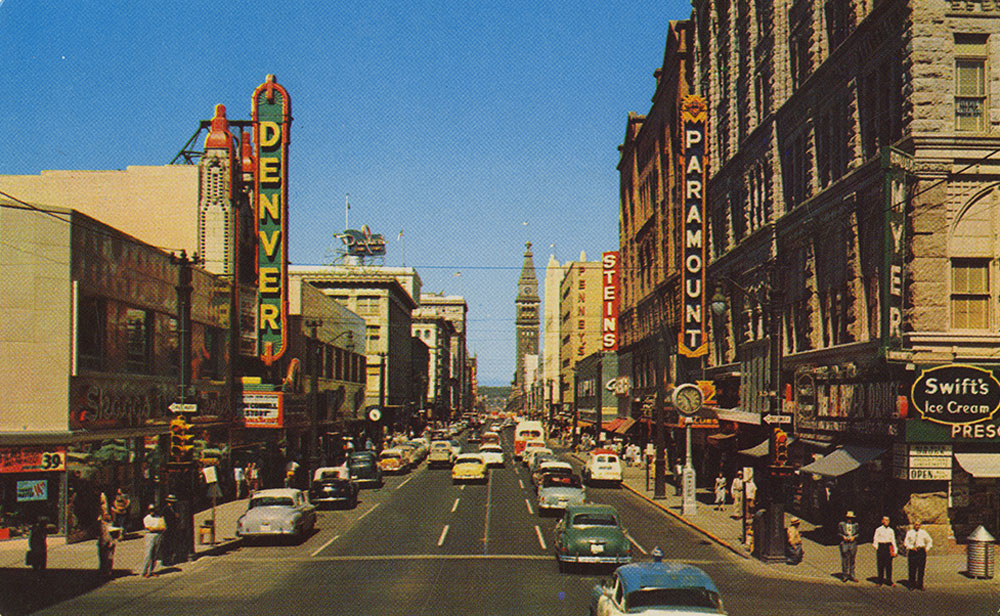 Downtown Denver, c.1950
It was around that time Al again ran into his old friend Neal Cassady. Neal’s wife, Luanne (Henderson), worked at a drive-in, and Al would give Neal rides in his convertible to pick her up. Neal was also involved with another woman, Jeanie Stuart, who had a friend, also named Jeanie, whom Al began to fall for. When Luanne found out about Neal’s affair, she demanded they leave Denver and make a new start in Nebraska. Al drove them to the edge of town, and they planned to hitchhike from there. Just as he dropped them off, the last snow of the year began falling.
After Al’s Jeanie abruptly informed him she’d accepted an offer from her aunt and uncle to live with them in Pasadena, he got a crazy notion to head back to California himself. He sold his car and took a Greyhound, arriving three days before she did, and got a room at the Rosslyn Hotel in Los Angeles. The next day he left two dozen roses on Jeanie’s porch with a note: “Welcome to California!” It didn’t work.
Al got a job for McKesson packing liquor shipments, but it wasn’t enough money. So when Al ran into Dicky Reed, an acquaintance from back home, they decided to hitchhike back to Denver together. When hitching wasn’t getting them far, they hopped a freight train, ending up in Dallas, Texas, and caught a ride from there to Chicago. Dicky got a job at a bowling alley, and Al got a job in the shipping department of the Baldwin piano factory.
But Al hated it in Chicago. It was cold and windy, and he couldn’t wait to move back to Denver. So before long he said goodbye to Dicky and made it home hitchhiking in just 48 hours. He got a job at the same burger joint where he’d worked at 15, and began spending a lot of his free time at Petersen’s pool hall, with a side hustle teaching other guys to play pinochle.
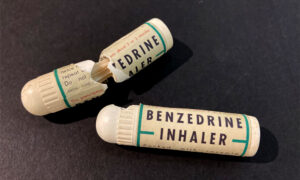 Benzedrine inhalers, props from On the Road (2012)
Meanwhile, Neal Cassady was in New York, where fellow Denverite and protégé of Justin Brierly, Hal Chase, had introduced him to the Columbia circle that included Allen Ginsberg and Jack Kerouac. Cassady was spending so much time with his new friends that Luanne had enough, and decided to head back to Denver. By the time Neal returned himself a couple months later, Ginsberg had fallen in love with him, and Kerouac thought he was the most fascinating character he’d ever met.
In spring of 1947, Ginsberg won the Boar’s Head Poetry Contest, and flush with prize money and pining for Neal, set out for Denver that summer. Kerouac soon followed, beginning the series of cross-country odysseys that became On the Road.
 Al Hinkle and friend on the SP railroad
Al’s parents had gone to California on vacation for two weeks, and unbeknownst to them, Al had a key to their downtown apartment—which meant two weeks of partying with the gang. (This portion of On the Road was trimmed considerably by its publisher, Viking, out of concern it might get them sued.)
This was also when Neal met Carolyn (née Robinson). At the time she was dating Bill Tomson, who’d affected the persona of a 24-year-old discharged Air Force captain taking classes at the University of Denver; none of which was true. He was really just 17, wearing a uniform he got from a surplus store. Bill wanted to show his girlfriend off to his friends, but that turned out to be a bad idea when Carolyn ended up leaving him for Neal.
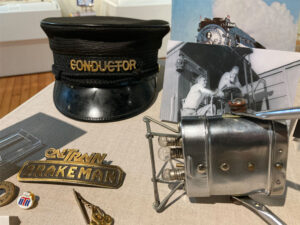 Some of Al Hinkle’s brakeman effects
The infamy of their two weeks’ hard partying spread further than anticipated, and Al found himself dodging his father once he returned to town. Nor was he welcome at the pool hall, as the police were asking about him. When he finally did run into his father, he was livid, and gave him an ultimatum: leave town or go to jail. His father bought him a ticket to San Francisco, where he got a room at the Acer Hotel in the Tenderloin. His uncle got him a job on the Southern Pacific railroad, first as an unpaid student brakeman. Al enjoyed the job—riding atop the cars, in the caboose, switching out boxcars—and it became a good career.
It was a cold, miserable day in Denver when Al returned for a visit, and again reconnected with Neal Cassady, who’d been in San Francisco during the time Al was working on the SP in San Luis Obispo. Neal wanted to return to SF to get an annulment from Luanne. He was impressed when Al showed him his pay stubs from the railroad. Neal had a 1939 Packard, and they soon hit the road back to San Francisco with a girl Neal was taking back to Oakland. The radiator blew ten miles out of Salt Lake City, and Al used a railroad flare to flag down a passing Greyhound. They fixed the car, and made it the rest of the way. Once in San Francisco, Al’s uncle Wally helped Neal get a student brakeman job. Carolyn, meanwhile, was staying with her sister, vying for a costume designer job in Hollywood. Neal and Carolyn got back together, and soon after Neal’s annulment was granted they married.
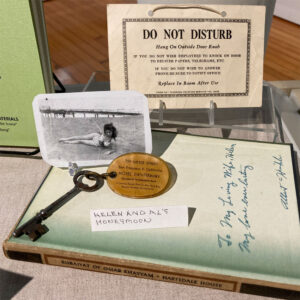 Al and Helen spent their wedding night at the Hotel Canterbury on Sutter St in San Francisco
Al found a basement apartment on Van Ness Ave, and around that time met Helen. “I was in San Francisco and looking for some good jazz. I especially liked jazz trumpet, and someone told me that this club called ‘Say When’ had a great jazz band with a hot trumpeter. So one Monday night I decided to go check it out.” It turned out the club was closed Mondays, but two young ladies, Helen and her friend Adele, were also there outside. Al suggested another club, but when the music wasn’t all that good, they went instead for a cup of coffee. Adele soon left the coffee shop, but Al and Helen stayed and talked til 3am, and afterward Al walked her home to her apartment at 18th & Valencia. After that they saw one another almost every day, and just two weeks later, on December 11, 1948, Al proposed. They were married on the 18th.
“That’s where all the trouble started!” Al joked. Since Hinkle and Cassady’s work on the SP was seasonal, and they were furloughed during the winter months, Al thought it would be a great opportunity for a honeymoon. Neal had also just used his and Carolyn’s savings (plus $100 from Al) to purchase a new 1949 Hudson—much to Carolyn’s dismay.
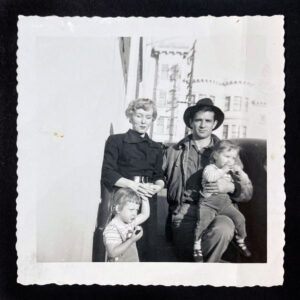 Carolyn Cassady & Jack Kerouac with Cassady children
Al, Helen, and Neal decided to hit the road together. But when Neal and Helen didn’t hit it off, Al used his rail pass to send Helen ahead to New Orleans, to stay with William Burroughs and Joan Vollmer. Still, Neal didn’t want to take the trip without a female companion, so they picked Luanne up in Denver before heading to Raleigh, North Carolina to pick up Kerouac. From there they drove to New York, where they stayed at Allen’s apartment.
Helen had been in New Orleans three weeks when they finally arrived. Burroughs was “a little put out,” but Helen was furious. So when Jack, Neal, and Luanne left to return to SF, Al hung back to repair things with his wife. They still hadn’t taken their proper honeymoon, so they rented a room in an old mansion on Esplanade so they could experience New Orleans. After a wonderful ten weeks, they returned to San Francisco by train.
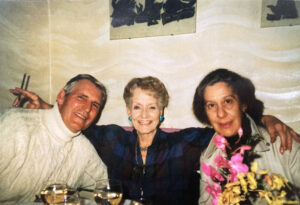 Al Hinkle, Carolyn Cassady, and Helen Hinkle
In the years that followed, the Hinkle and Cassady families became very close. Al, in particular, was a grounding figure and stabilizing presence amidst often turbulent personalities, a loyal friend through both good times and trying ones. When Neal would disappear and philander, Al was the first person Carolyn would call for help and support. When Neal went to prison in 1958, after giving three joints of marijuana to an undercover officer, Al even purchased the Cassady home to ensure they wouldn’t lose it.
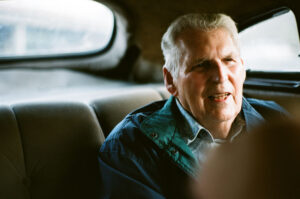 Al Hinkle in 2011, driving up the coast in the 1949 Hudson following the filming of On the Road (2012). Photo by Gregory Smith.
Al and Helen enjoyed many more adventures together throughout their long marriage. They toured Europe frequently, each time buying a Volkswagen to drive around. At the end of the trip, Al had the car shipped back to the States, and sold it once they returned home. Helen passed away in 1994. Al became known as the “Last Man Standing,” having outlived all his Beat friends and contemporaries, and in his later years was a frequent guest at the Beat Museum, regaling audiences with stories of his life and times. Al Hinkle died in Los Gatos in 2018 at the age of 92, survived by his daughter, Dawn, and son, Mark. Al’s reputation as a gentle giant, a kind and loyal friend with a heart of gold, was well earned.