Sun. August 9, 6pm
Pat Thomas returns to the Counterculture Museum for a presentation on his exquisite compendium, Evergreen Review: Dispatches from the Literary Underground: Covers & Essays 1957-1973, published by Fantagraphics. Peter Richardson presents his latest book, Brand New Beat: The Wild Rise of Rolling Stone Magazine, (Univ. of California Press). Book signing to follow.
Pat Thomas is the author of Listen, Whitey! The Sights & Sounds of Black Power 1965-1975, Did It! Jerry Rubin: An American Revolutionary, and co-editor of Invitation to Openness: The Jazz & Soul Photography of Les McCann 1960-1980. In co-operation with the Estate of Allen Ginsberg, Thomas edited the visual tome Material Wealth: The Personal Archives of Allen Ginsberg, with a forward by poet Anne Waldman, which won a PEN award in 2024. Thomas was the co-editor of Ernie in Kovacsland: Drawings, and Photographs from Television’s Original Genius and Grievous Angels, Trout Masks, and American Beauties: 1970s Rock & Roll Photography of Ginny Winn with an introduction by Maria Muldaur. His most recent book is the absolutely gorgeous Evergreen Review: Dispatches from the Literary Underground: Covers & Essays 1957-1973, published by Fantagraphics. He lives on America’s left coast.
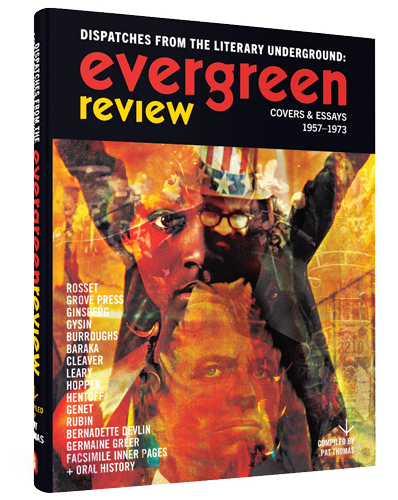
The magazine of the Beat Generation returns in this awe-inspiring compilation of the art, essays and photography of the avant-garde Evergreen Review.
From the late 1950s to the mid-70s, work by contributors like Allen Ginsberg, William Burroughs, Amiri Baraka, Eldridge Cleaver, Tim Leary, Dennis Hopper, Jean Genet, Jerry Rubin, Bernadette Devlin, and Germaine Greer regularly appeared in the countercultural magazine Evergreen Review. Their subversive work and radical politics defined outsider literature for an entire generation. Edited by Barney Rosset of Grove Press, Evergreen Review was a quarterly illustrated/photography driven reflection of that genre.
For the first time ever since their original print date, full color reproductions of all front covers of all 100 issues of the Evergreen Review from 1957 to 1973, plus hundreds of pages from many of the issues are reprinted exactly as they looked then – with all illustrations, photography, even the ads for other books, albums, letters to the editor, subscription offers, etc – left intact!
Historian Pat Thomas interviewed original 1960s era Evergreen staffers to get the inside scoop on the day-to-day operation of the magazine, and those conversations join new essays looking back on this golden era by John Oakes, Loren Glass, Kasia Boddy, Dale Peck, Ethan Persoff, Ken Jordan and Stanley Gontarski. Will this new Evergreen Review change the world as it did in the 1960s? Of course it will!
Peter Richardson is author of Savage Journey: Hunter S. Thompson and the Weird Road to Gonzo as well as critically acclaimed books about the Grateful Dead, Ramparts magazine, and radical author and editor Carey McWilliams. His essays appear in The Nation, The New Republic, the Los Angeles Times, and elsewhere.
“Brand New Beat is a highly engaging, deeply researched, and sharply etched account of the early years of Rolling Stone magazine, told with greater acumen and detail than any other account. This is a tantalizing and fantastically gossipy book, full of stories and anecdotes that are a delight to encounter for the first time.”―John McMillian, author of Beatles vs. Stones and founding coeditor of The Sixties: A Journal of History, Politics, and Culture
“Colorful and riveting. Peter Richardson makes a convincing case for Rolling Stone‘s continued importance while acknowledging the voices who were unjustly written off from behind its boys’-clubhouse doors.”―Evelyn McDonnell, author of The World According to Joan Didion
“The San Francisco Bay Area was ripe for Rolling Stone in the 1960s and ’70s. Counterculture and pop culture had briefly merged. Jann Wenner and company were smart to deliver music and sociopolitics as a heady brew on newsprint that college kids found intoxicating. Richardson beams you back to that zeitgeist.” ―Pat Thomas, editor of Evergreen Review: Dispatches from the Literary Underground, 1957–1973
“Magazines may be struggling, but histories of the most impactful of those publications―and the people who put them together―continue to fascinate appreciative readers. Rolling Stone, a rambunctious, playful child of the sixties, became a bible not just of rock, but of popular culture, and rocketed from San Francisco to Manhattan and to higher highs, until numerous phenomena―competition, demographics, high tech―halted the ride. Richardson chronicles that ride by doing what the best of Rolling Stone bylines offered: diligent research, deep reporting, revelatory background stories about the major players, and perceptions on what it all meant. What it all means. To paraphrase and counter Bob Dylan: it ain’t over yet, Baby Blue.” ―Ben Fong-Torres, former senior editor, Rolling Stone
“Once upon a time, Rolling Stone was required reading for Americans. Its first decade brought us a wonderland of intelligent journalism from Hunter S. Thompson, Tom Wolfe, and others, such as Ben Fong-Torres, Annie Leibovitz, and Grover Lewis. Richardson, the Bay Area’s historian laureate, takes us back to those golden days when the magazine hit the note in every issue. Back then, when the magazine arrived I’d go into my Rolling Stone coma, not regaining consciousness until I’d read every word. I miss those days, but Richardson’s fantastic book brings back that delightful illness. What a time it was.”―William McKeen, author of Outlaw Journalist: The Life and Times of Hunter S. Thompson
“Here, we finally―finally―have the real story of the beginnings of Rolling Stone in 1960s San Francisco, from its birth in the counterculture and radical politics of the time to its belief that music could set you free and its enthusiasm for new literary writing and the New Journalism. Rather than relying on the tired old tropes of sex, drugs, and rock and roll, Richardson’s serious research recontextualizes history to describe the motley group of young writers, editors, and staff―led by a charismatic editor―who put out a publication that went up against the mainstream. Brand New Beat captures the facts and the spirit of the times.” ―Sarah Lazin, literary agent, founder of Sarah Lazin Books and former director of Rolling Stone Press
“These days, some of the historic figures in Richardson’s book must wag their fingers, like that Bush-era bumper sticker says, ‘Never thought I’d miss Nixon…’ With mass deportations and the assault on law, the academy, and logic itself, some of what Rolling Stone founding editor Jann Wenner waded into now looks like kid stuff. Beginning with its special issue on the violence at the Altamont Speedway Free Festival in 1969, the magazine covered stories the mainstream (establishment) press ignored: Karen Silkwood and Patty Hearst just for a start. Along the way, Rolling Stone let music chart a new map, one that we shouldn’t take for granted. Eavesdrop as Hunter S. Thompson and Lester Bangs plead for more money and space, and Wenner steers record labels toward their ideal audience. Brand New Beat recaptures the times, and the inspiration behind them.” ―Tim Riley, author of Substack’s riley rock report and Lennon: The Man, the Myth, the Music―The Definitive Life
“A must read! Richardson’s Brand New Beat is illuminating, engaging, and important. Moving beyond the usual narratives of Rolling Stone focused on Jann Wenner, it instead tells the more complicated (and long overdue) story of the geographical, social, political, and media culture that made Rolling Stone and its massive success possible.” ―Kimberly Mack, author of Fictional Blues: Narrative Self-Invention from Bessie Smith to Jack White.
Standard CCM admission applies. Members get free admission.